

Trauma-focused therapy intensives
Trauma Therapy Intensives for Women in Lancaster, PA
Focused, in-person trauma therapy over three to five consecutive days in Lancaster, Pennsylvania. A dedicated stretch of time to explore what understanding alone hasn't fully resolved, with room to slow down, listen, and work with what emerges.



Intensive or weekly therapy?
Weekly therapy fits into your life. An intensive sets time apart from it.
An intensive sets aside the usual rhythm of daily life (the inbox, the school pickup, the demands that are easy to get pulled into) so we have consecutive days to focus on the work. Some people find the setting restful. At its core, it's focused trauma therapy.
Both formats have their place. The main difference is the amount of uninterrupted time available.
Weekly therapy
About 30 sessions, spread across 9 months or more
- Each session50 to 60 minutes
- The rhythmRegular meetings woven into everyday life
- ContinuityReturning to the work over time, with space to reflect between sessions
- In betweenTime to notice how things unfold in daily life
- Often a good fit forOngoing support, working with emerging concerns, and making room for therapeutic work alongside everyday life
A 3- to 5-day intensive
About 18 to 30 hours of therapy, over three to five consecutive days
- Each day9am to 4pm, with approximately six hours of therapy and time for lunch and breaks
- The rhythmResponsive to what emerges, with room to pause or adjust
- ContinuityEach morning picks up close to where the previous day left off
- In betweenTime outside the therapy room to rest and let the day settle, with space to consider what support may be helpful that evening
- Often a good fit forFocused time with something specific you'd like to explore in depth
Room to respond to what emerges
With the whole day available, we can slow down, pause, or shift direction when that seems useful, without watching the clock for the end of a session.
Continuity
What begins in the morning can be followed through in the afternoon, and picked up again the next day.
Time apart from daily life
For a few days, you step out of your usual roles and routines, which can leave more room to notice what's been underneath.
Research on intensive trauma treatment is still developing. One randomized trial found that a seven-day intensive format of cognitive therapy for PTSD produced outcomes comparable to the same treatment delivered weekly over three months, with improvement occurring more quickly in the intensive condition. The study examined cognitive therapy, not EMDR or somatic approaches, so its findings shouldn't be assumed to apply directly to every intensive format. Both intensive and weekly therapy can have a place, depending on the person and their circumstances.
Who this format is designed for
It may fit if some of this feels familiar.
- You may have done meaningful therapeutic work already, and you're curious about what could help it go further.
- You may function well at work and in relationships, and sense a layer underneath that insight hasn't fully reached.
- You may be able to name your patterns clearly, while they still show up in ways you'd like to change.
- You may sense the roots are early and relational, and you'd like more time to give them attention.
- You may want a dedicated stretch of time, away from the everyday demands that are easy to get pulled into.
- You may prefer focused time over a few days to spreading the work across many months.
An intensive isn't the right fit for everyone, and that's okay. Our first conversation is a real discussion about fit and readiness, and if it isn't the right match, I'll tell you honestly.
What each day looks like
Focused work, from morning to late afternoon.
Each day runs from 9am to 4pm, with approximately six hours of therapy and time for lunch and breaks. Each intensive is shaped around your history and goals, so no two days look exactly alike.
Arriving
Each day usually begins with a grounding practice and a check-in about where you are.
The morning's work
Depending on what we're exploring, this may draw on Somatic Experiencing, EMDR, Deep Brain Reorienting, IFS, or sand tray.
Midday
A lunch break to step away, eat, rest, or walk, in whatever way you choose.
The afternoon
The work continues, sometimes in a different direction, and sound may be used for rest and grounding.
Closing
Each day ends with time to reflect and ground before you leave.

Who you'll work with
I'm Vanessa Simmons, LPC, SEP.
I specialize in developmental and attachment trauma, especially with women who are often the ones others lean on.
I'm a Licensed Professional Counselor, an EMDRIA Certified Therapist, Approved Consultant, and Approved Trainer, and a Somatic Experiencing Practitioner. I also draw on Deep Brain Reorienting, Internal Family Systems, sand tray, and sound. Every intensive is one-on-one with me, from the first call to the final day.
What your days can hold
An intensive holds more than reprocessing.
Whatever length you choose, the days include time for preparation, rest, and closing alongside focused trauma work. Each intensive is shaped around you, and it may include:
Arriving in the space
Time to arrive, get comfortable, and begin.
Shaping the focus
Identifying the memories and experiences to focus on, including preverbal experiences when they're part of the picture.
Getting to know yourself
Exploring the patterns, parts, and responses that have helped you cope.
Supportive practices
Practices that may include mindfulness, gentle movement, and sound meditation.
The deeper work
Working with the memories we've identified together. The time each memory needs varies from person to person.
Gathering what's shifted
Reflecting on our time together and planning for the weeks ahead.
These don't follow a fixed order. We can pause, slow down, or change direction as the work unfolds.
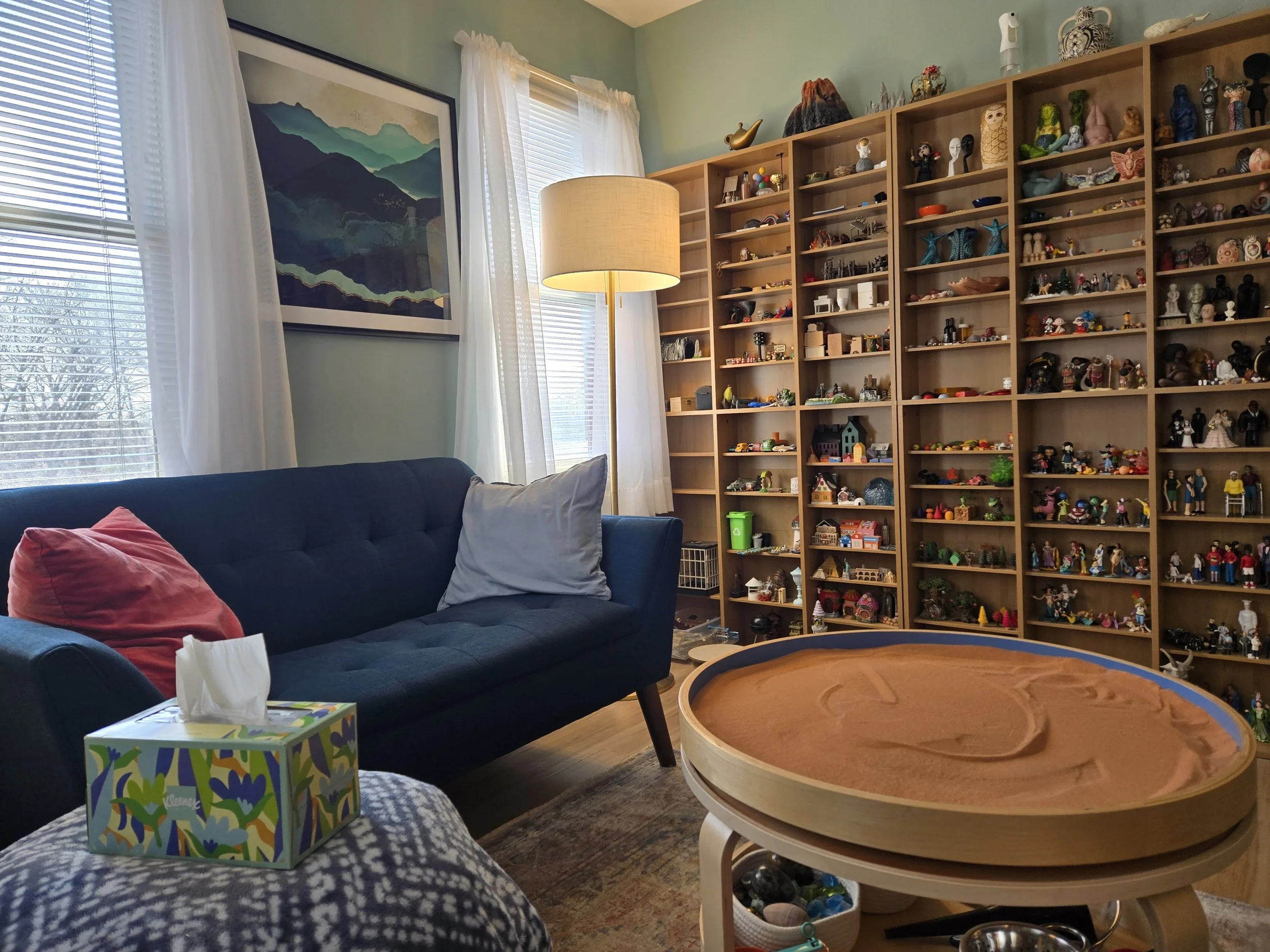
The office, Lancaster, Pennsylvania
The space
A space prepared for this work.
I set up the office for longer days of trauma therapy, with privacy, natural light, and room to move.
- Sand tray. A full sand tray with hundreds of miniatures, available throughout your intensive, for working with images and symbols when words are hard to find.
- Sound. Crystal bowls, gongs, chimes, drums, and voice, used mainly for rest and grounding between more focused work.
- Privacy and comfort. A quiet, private suite with natural light and considered details. Coffee, tea, snacks, and water are available, selected with your preferences in mind.
Every intensive includes
Built around you, from the first call to the final day.
A 45-minute call
A real conversation about your history, your goals, and whether an intensive makes sense right now. Complimentary, with no obligation.
Your preparation guidebook
Once your dates are reserved, a guidebook helps you arrive oriented and lets us begin shaping the focus before you arrive.
Three to five days together
In person, beginning on a Monday. Each day runs from 9am to 4pm, with approximately six hours of therapy and time for lunch and breaks.
Investment
A meaningful investment in focused, private care.
Many women who seek an intensive have spent years learning about themselves through therapy or other forms of personal growth. They may be curious about what focused time, and a different way of working, could offer.
All therapy at Meadow Grove is self-pay. Intensives aren't billed to insurance directly, and HSA and FSA cards are accepted, with superbills available for possible out-of-network reimbursement. See intensive pricing and payment.
Trauma-focused intensive
Three to five days
per day, 9am to 4pm, with approximately six hours of therapy
- Three days$4,500
- Four days$6,000
- Five days$7,500
Begins with a complimentary 45-minute call. A deposit of $1,500 reserves your intensive dates, and you'll receive the cancellation and rescheduling terms in your informed consent documents before committing.
The 3- to 5-day intensive
Focused trauma work, which may include reprocessing difficult memories with EMDR or other approaches. This is often what people mean when they say they're ready to address something more deeply.
Nourish Your Nervous System
A single 3-hour session devoted to resourcing: grounding, regulation skills, and self-awareness, without memory reprocessing. For some it's a first step; for others it's what they were looking for.
$750 · See pricing details

Practical information
Traveling to Lancaster for your intensive.
- Harrisburg International (MDT)about 40 min
- Philadelphia International (PHL)about 1.5 hrs
- Baltimore/Washington (BWI)about 1.5 hrs
- Washington Dulles (IAD)about 2.5 hrs
- New York JFKabout 3 hrs
Approximate drive times. Amtrak's Keystone line also runs direct to Lancaster from New York and Philadelphia. Clients travel from across the U.S. and around the world.
All intensive sessions are held in person at Manor West Commons, 2938 Columbia Avenue, Suite 702, Lancaster, PA 17603.
A deposit of $1,500 reserves your intensive dates, and you'll receive the cancellation and rescheduling terms in your informed consent documents before committing. A local guide offers suggestions for where to stay, walk, eat, and find quiet between sessions.
Questions about the intensive
What people often want to know.
What's the difference between a therapy intensive and weekly therapy?
Weekly therapy fits into your life, one 50 to 60 minute session at a time, and offers steady, ongoing support. An intensive sets time apart from daily life. Each day includes approximately six hours of therapy, so three days offers roughly 18 hours and five days about 30, around what five to nine months or more of weekly sessions provides. The continuity can make it possible to stay with something longer than a single session allows. Many people benefit from both at different times.
Is a therapy intensive the same as a trauma retreat or EMDR retreat?
Not quite. Like a retreat, an intensive takes you out of your daily routines for a few days. The focus, though, is private, one-on-one trauma therapy with me, in person in Lancaster, Pennsylvania. Lodging and meals aren't included; you stay wherever feels comfortable nearby, and a local guide helps you plan.
How many days should I choose?
Intensives run three, four, or five consecutive days. Three days provides substantial time for focused work. Four or five days allow more time for exploration, breaks, and integration before the intensive concludes. The best length depends on your goals and circumstances.
I'm not sure whether to start with Nourish Your Nervous System or an intensive.
The intensive is the primary offering: focused trauma work with the time and continuity to explore something in depth. Nourish Your Nervous System is a single 3-hour session for resourcing, at $750, and it doesn't include memory reprocessing. You don't need to decide on your own; we can talk through which fits on your 45-minute call.
What does a typical intensive day look like?
Each day runs from 9am to 4pm, with approximately six hours of therapy and time for lunch and breaks. Each day opens and closes with time to ground and check in, and the work in between responds to what emerges.
What happens after an intensive ends?
The final day includes time to gather what has shifted and plan for the weeks after. That may include returning to your current therapist, routines at home, or time to rest. Some people feel lighter right away; others notice changes over the following weeks, and some find that things feel unsettled for a while before they settle.
When might an intensive not be the right fit right now?
An intensive involves concentrated therapeutic work over a short period. Depending on what you're experiencing and what support is available to you, another form of care may be a better starting point. For example, we may need to consider additional or more specialized support if you're experiencing:
- OCD symptoms that haven't had specialized treatment. Concentrated trauma work can sometimes intensify intrusive thoughts, so we'd talk about whether specialized OCD care, first or alongside, would make sense.
- Substance or alcohol use that feels hard to manage. Trauma work asks you to stay present with difficult material, and we'd talk about what recovery support might be needed.
- Thoughts of suicide or of harming someone else that include a plan or intent. This calls for immediate, ongoing support close to home. Passing thoughts without a plan or intent don't automatically rule an intensive out; we can talk about them openly on your call.
Readiness depends on more than a diagnosis, including what you're experiencing now, the support around you, and what kind of care you may need. None of this reflects your worth. If an intensive isn't the right fit right now, I can help you think through what kind of support might be a better starting point. If you're in crisis, you can call or text 988 in the U.S., any time of day.
Does insurance cover a therapy intensive?
Intensives at Meadow Grove are self-pay and aren't billed to insurance directly. HSA and FSA cards are accepted, and a superbill is available for possible out-of-network reimbursement. Intensives are $1,500 per day: $4,500 for three days, $6,000 for four, or $7,500 for five. A deposit of $1,500 reserves your intensive dates.
You don't have to know exactly what you're looking for to begin a conversation.
If you're curious about whether a therapy intensive might be a good fit, I'd be glad to talk with you. Our 45-minute call is a chance to share what brings you here, ask questions, and explore whether this way of working makes sense for you right now.
There's no expectation to decide during that call. We can start there and see what becomes clearer.
If you're in crisis or don't feel safe right now, you can call or text 988 in the U.S. to reach the Suicide & Crisis Lifeline, any time of day.
This works best for people who recognize themselves in most of this.
Intensive work is not right for everyone. The first conversation is a real discussion about fit, readiness, and format. If it is not the right match, that will be said directly.
EMDR Intensive Therapy Pennsylvania, What to Expect
Every intensive at Meadow Grove is built around you specifically. Before you arrive, Vanessa will have prepared the space with care. There is no generic program here, only your particular history, your nervous system, and what it is ready for.
Each day typically runs approximately 9am to 4pm, with a midday break.
The space itself is intentional. Sound, scent, and light are considered before you arrive. The sand tray is available throughout. Nothing here is accidental.
Prepared before you arrive. Held carefully while you are here.
The office at Meadow Grove is not a standard therapy room. It was designed specifically for this kind of work, unhurried, immersive, and attentive to what the nervous system needs to feel safe enough to go somewhere real.
Nothing in this space is accidental. It was put together with the specific needs of intensive work in mind.
See more of the officeBuilt around you, from the first call to the final day.
A complimentary 45-minute phone call, a genuine conversation about your history, fit, and readiness, and whether this format makes sense for where you are right now. No obligation. No pressure.
Once a deposit reserves your dates, you'll receive a guidebook to work through at your own pace. It helps you arrive oriented, and gives the intensive a head start on being shaped around you.
In person in Lancaster, 9am to 4pm daily, with breaks built in. Paced to what your nervous system can take in and integrate.