

Sand therapy within trauma therapy intensives
Sand therapy: a way in for what words can't yet reach.
A tray of sand, a world of small figures, and room for something to take shape before it has language. Woven into the 5-day intensive by Vanessa Simmons, LPC, SEP, with foundational and advanced sand therapy training.
Sand therapy is available within the 5-day intensive, held in person in Lancaster, Pennsylvania. It isn't offered as a standalone service.
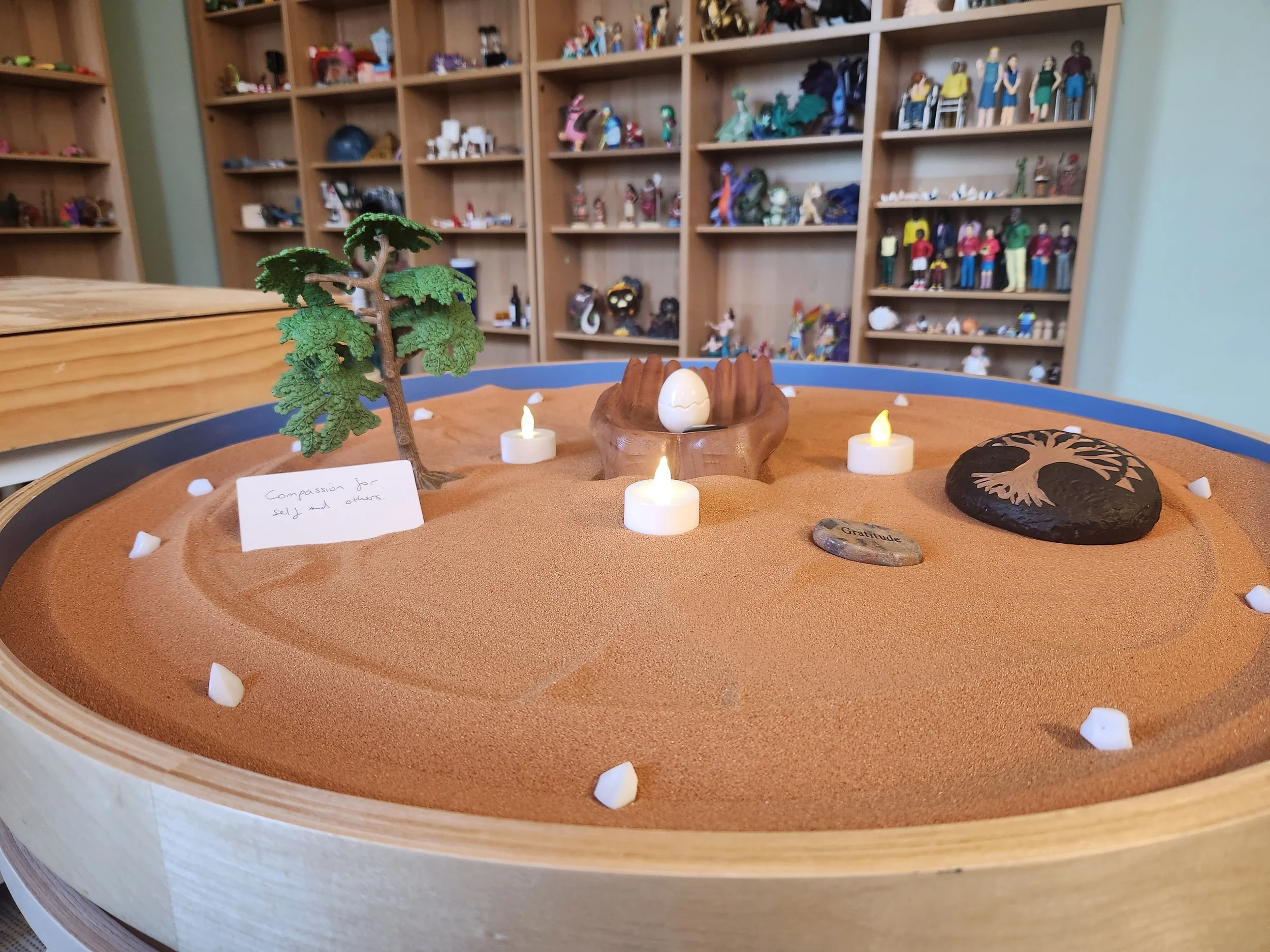
A sand tray created by a non-client, shared for illustration. Client work is never photographed or shared.
What sand therapy is
Meaning made with the hands, as well as with words.
Sand therapy, also called sandtray, uses miniature figures, objects, and a tray of sand to create three-dimensional scenes that reflect parts of your inner experience. Its roots trace back to the work of Margaret Lowenfeld and Dora Kalff, and it has been developed and studied for decades since.
Not everything we carry has organized itself into language. Some experiences are preverbal. Some are held in the body in ways that talk alone hasn't reached. Some simply feel easier to approach at a gentle distance, through symbol and image instead of direct description.
What appears in the tray often surprises the person who made it. There's nothing to interpret cleverly or get right. The images do their own quiet work, and Vanessa's role is to witness and stay curious alongside you.
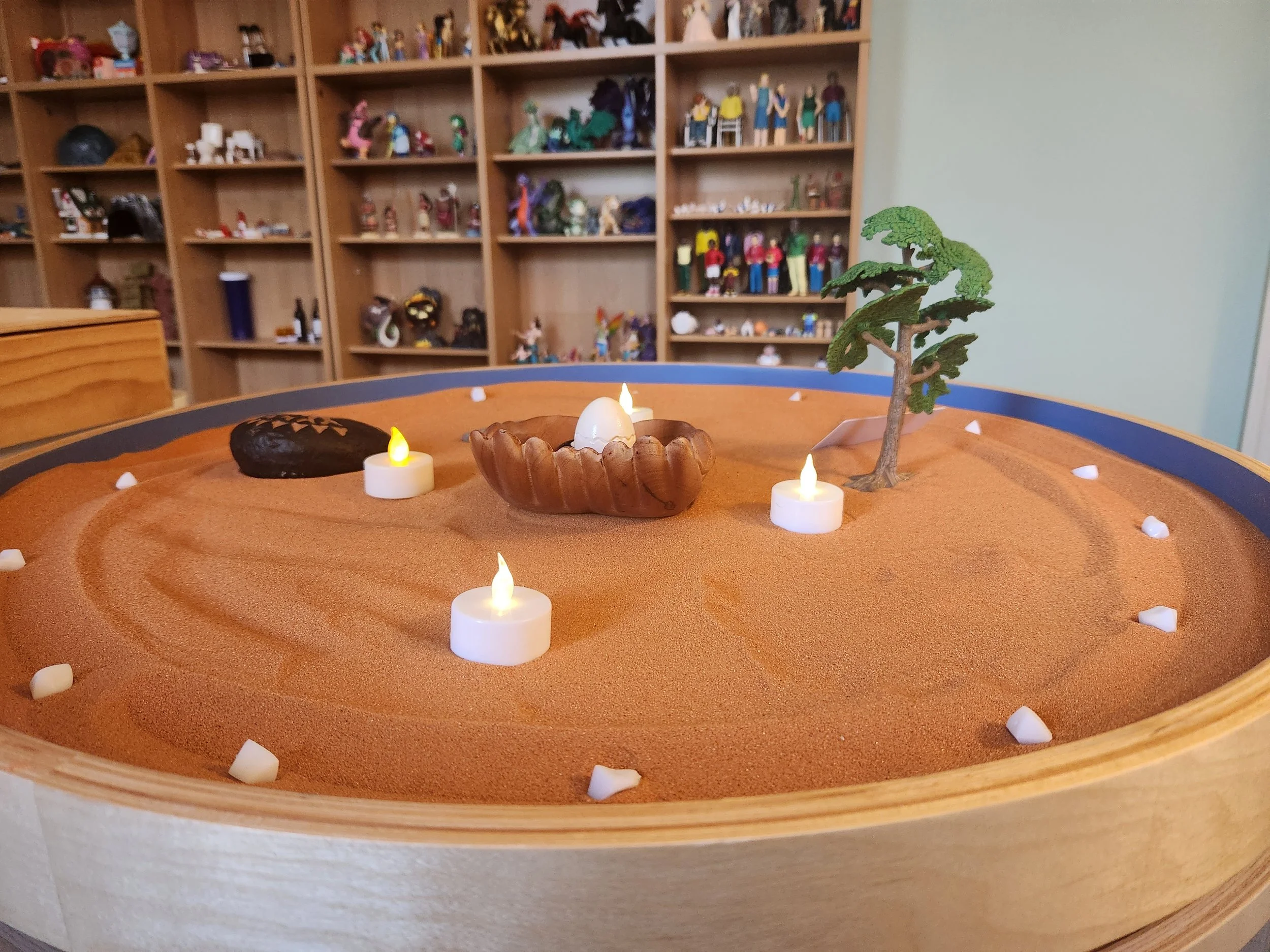
A sand tray created by a non-client, shared for illustration. Client work is never photographed or shared.
You might be curious about this if
A gentler door when talking meets its limits.
A few examples of what can draw people toward this work. They're illustrations, not requirements, and you don't need to identify with all of them to begin.
- A sense that talk therapy has circled without quite reaching what matters most
- Experiences that feel hard to approach directly, or to put into words
- Early experiences that predate language, or that were never spoken aloud
- Curiosity about what might emerge when the thinking mind is invited to step back
Training and lineage
Studied deeply, with some of the field's most respected teachers.
Vanessa has completed foundational and advanced sand therapy trainings, including the EMDR Sandtray Specialist Intensive Program through the AGATE Institute.
Her study has been shaped by leading voices in the field, including:
Contemporary sand therapy draws on traditional methods alongside current understanding of the nervous system, relational research, and mindfulness. Here, it's careful, well-grounded work, integrated with the other approaches offered.
Learn more from the World Association of Sand Therapy Professionals and the Sand Tray Training Institute of New Mexico.
Within your intensive
A full sand tray, available throughout your days here.
A complete sand tray with hundreds of miniatures is available throughout your intensive, ready whenever the work calls for it.
Sand therapy isn't a standalone part of the week. It sits alongside the body-centered work as another way in, especially for early or preverbal material, and pairs naturally with IFS. It's woven together with EMDR, Somatic Experiencing, and Deep Brain Reorienting as your system needs it.
Sand therapy is offered as part of therapy, never as a promise of any particular result. What emerges is different for everyone, and always at your pace.
Common questions
What people ask about sand therapy.
Can I book sand therapy sessions on their own?
Sand therapy is offered as part of the 5-day trauma therapy intensive rather than as a standalone service. A full sand tray with hundreds of miniatures is available throughout the intensive, drawn on alongside EMDR, Somatic Experiencing, Deep Brain Reorienting, IFS, and sound therapy for nervous system support.
Do I need to be artistic, or do it the right way?
No. There's no correct way to build a tray and nothing to interpret cleverly. You choose what draws you and arrange it however feels right. The images tend to do their own work.
Is sand therapy just for children?
No. Sand therapy is well known in work with children, and it's also used with adults. For adults, it can be especially helpful for early or preverbal experiences that are hard to approach directly in words.
Do I have to explain what I make?
No. You're never required to analyze or narrate your tray. The work can unfold through the images themselves, with Vanessa witnessing alongside you.
Will my sand tray be photographed or shared?
No. Client sand trays are never photographed or shared. The trays shown on this website were created by a non-client for illustration only.
How does sand therapy fit with the rest of the work?
Sand therapy is integrative. It can be woven together with EMDR, Somatic Experiencing, and IFS, and it pairs naturally with parts work, giving something a way to be seen before it has words.
Curious what might take shape when words step back?
The first step is a short, unhurried phone conversation. No forms, no pressure, and no obligation.
If you're in crisis or don't feel safe right now, you can call or text 988 in the U.S. to reach the Suicide & Crisis Lifeline, any time of day.